Audio system · Source published
Auralis
Explainable audio recognition with secure full-stack workflows.
An experimental audio-recognition application that analyzes microphone or uploaded clips, ranks an original catalog, and explains confidence through signal and score diagnostics.
- Role
- Product direction, full-stack architecture, audio-analysis workflow, interface design, testing, and release verification.
- Year
- 2026
- Status
- Source published
- Stack
- React · TypeScript · Fastify · PostgreSQL · Prisma · Web Audio API · Zod · Vitest
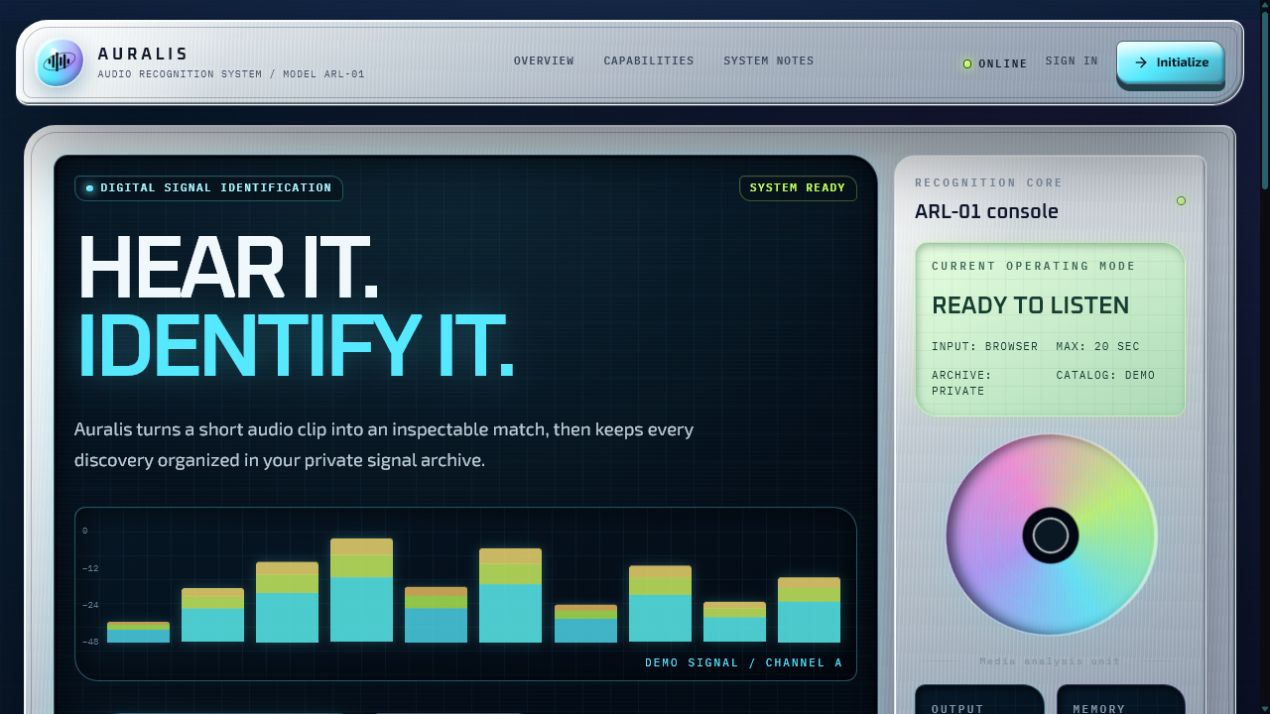
Overview
Auralis is an experimental full-stack audio-recognition application for capturing or uploading a short clip, extracting signal characteristics, receiving ranked matches, and retaining private recognition history and favorites.
Problem
Commercial music recognition requires infrastructure and catalogs beyond the scope of a portfolio project, while fake predetermined results provide little engineering value.
Solution
Auralis implements a smaller transparent recognition pipeline using original generated audio, browser-derived PCM descriptors, strict backend validation, ranked candidate scoring, and explicit confidence diagnostics.
Feature evidence
Capture and upload
Microphone recording and bounded audio uploads enter one analysis workflow.
Signal analysis
PCM features cover frequency bands, envelope behavior, pitch, and harmonic estimates.
Explainable ranking
Candidate scores, runner-up gaps, signal quality, and confidence states remain visible.
Private library
Authenticated history, favorites, and dashboard analytics are server scoped.
System layers
A React client decodes audio and derives bounded descriptors. Shared contracts validate the handoff to Fastify, where the recognition engine scores an original catalog and persists user-owned history.
- 01
React + Web Audio
Capture, decoding, PCM extraction, and visual diagnostics.
- 02
Shared contracts
Audio limits and descriptor validation.
- 03
Fastify API
Authentication, byte-level validation, and recognition coordination.
- 04
Recognition engine
Ranked catalog scoring and confidence diagnostics.
- 05
PostgreSQL + files
Private history, favorites, catalog, and staged storage.
Where the engineering concentrates.
Treating client audio as untrusted
Browser-derived descriptors are useful for analysis but remain input that the server validates and bounds.
Confidence without false certainty
Signal quality and the gap between ranked candidates influence explicit confidence states.
Choices and tradeoffs.
Original bounded catalog
The recognition pipeline demonstrates real matching without pretending to cover commercial music.
Byte-level file detection
Container and media evidence are checked independently of filenames and request headers.
Compensating cleanup
Filesystem and database failures trigger explicit cleanup behavior.
Synchronous processing
The current scope favors an inspectable request lifecycle over background infrastructure.
Security, accessibility, and testing.
Security
- Authenticated private history and favorites
- File type detection from bytes
- Independent container metadata validation
- Bounded duration and sample-rate inputs
Accessibility
- Text equivalents for visual diagnostics
- Keyboard-operable capture and upload flows
- Confidence communicated with labels, not color alone
- Responsive media-console layout
Testing
- Vitest checks for audio utilities and score behavior
- Validation tests for descriptors and upload limits
- Recognition confidence and runner-up behavior
- Failure cleanup verification
Current boundaries
The current product has a deliberate scope. These boundaries define what it does not claim.
- Small synthetic catalog
- Browser features are not cryptographically tied to uploaded audio
- No production acoustic fingerprinting
- No arbitrary commercial-song recognition
- Local storage is not horizontally scalable
- Processing is synchronous
The next credible steps.
- 01Move processing to a durable job boundary
- 02Bind server-derived features more closely to stored audio
- 03Replace local storage with an object-storage adapter
- 04Expand the original test catalog carefully
Verified product views
Genuine captures from the implemented product across core workflows and responsive layouts.
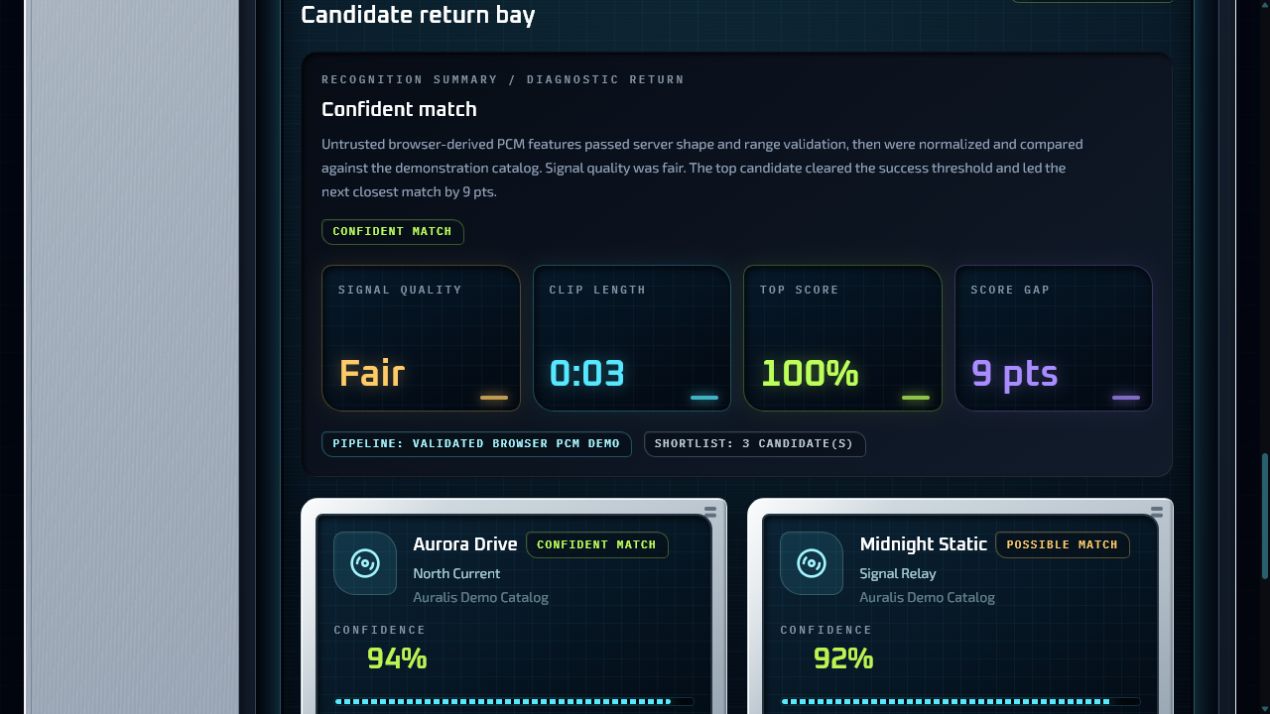
Recognition result and confidence diagnostics Audio-recognition landing experience 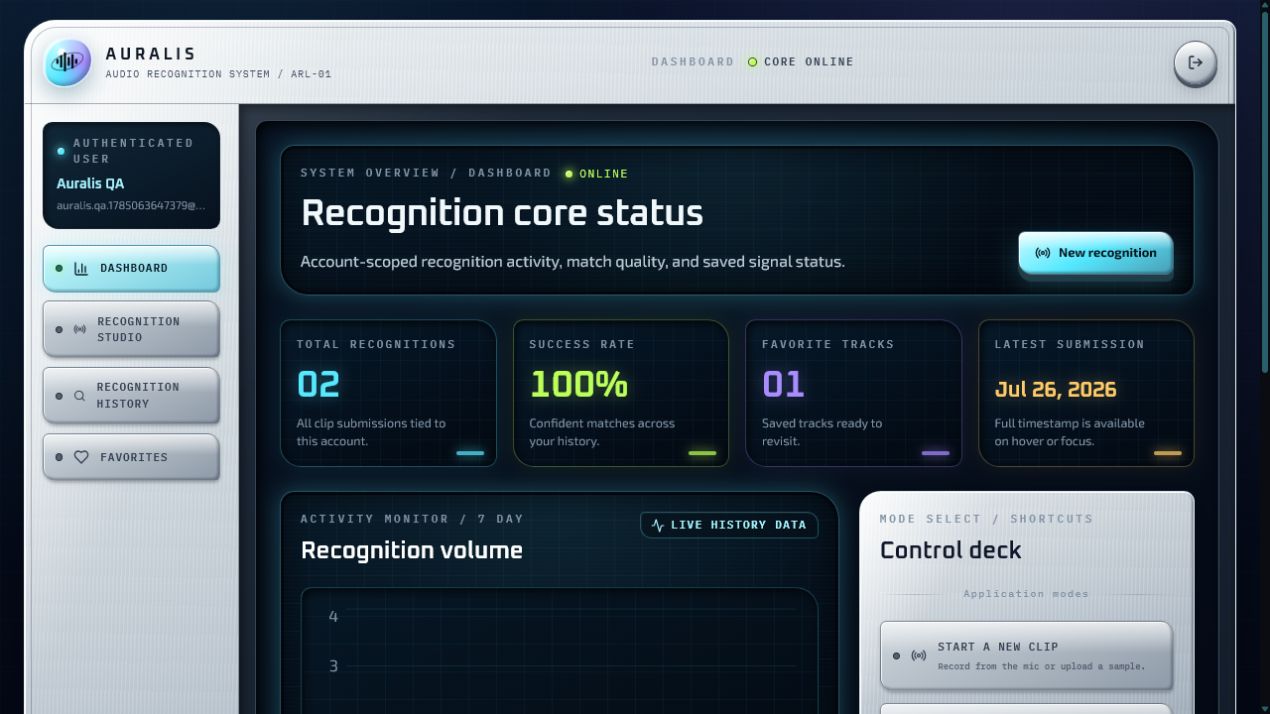
Private recognition dashboard 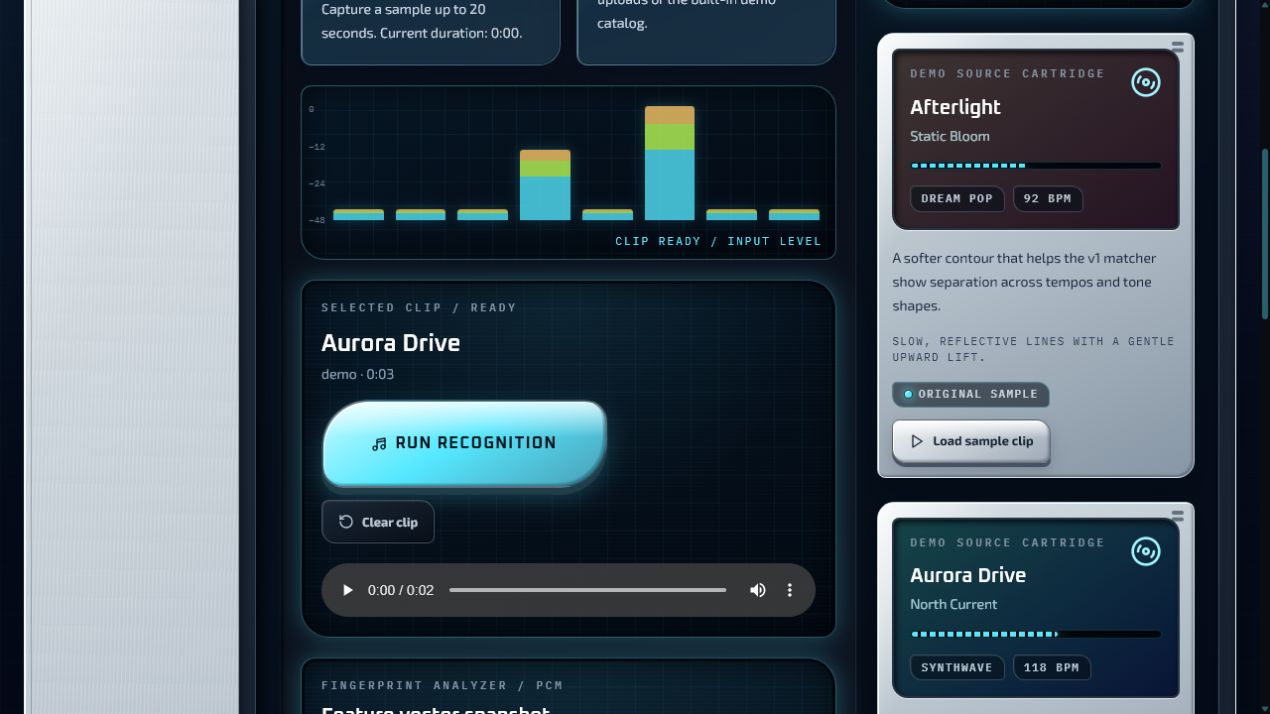
Prepared capture and upload studio 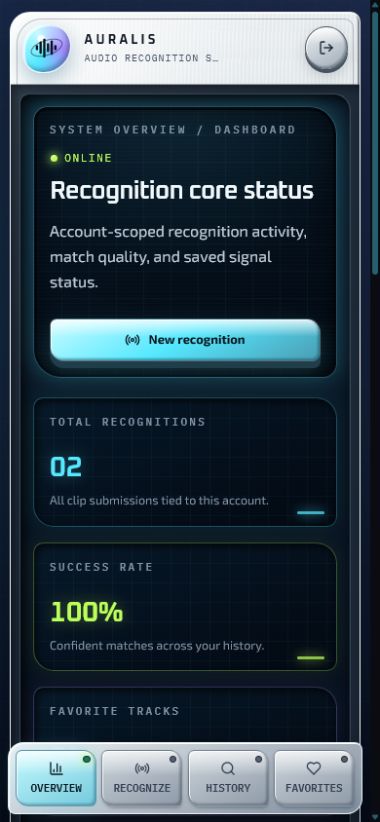
Mobile recognition controls
What the implementation clarified.
- 01
A bounded original catalog demonstrates real ranking behavior without overstating commercial recognition coverage.
- 02
Confidence becomes more useful when it exposes signal quality and distance from the runner-up, not just a top score.
- 03
Upload safety requires independent checks of bytes, container evidence, duration, and sample-rate boundaries.